

“Who dares despise the day of small things, since the seven eyes of the Lord that range throughout the earth will rejoice when they see the chosen capstone…”
“…’in the hand of Zerubbabel?'”
Vision of the Lampstand and Olive Trees
Now the angel who talked with me came back and wakened me, as a man who is wakened out of his sleep. 2 And he said to me, “What do you see?”
So I said, “I am looking, and there is a lampstand of solid gold with a bowl on top of it, and on the standseven lamps with seven pipes to the seven lamps. 3 Two olive trees are by it, one at the right of the bowl and the other at its left.” 4 So I answered and spoke to the angel who talked with me, saying, “What arethese, my lord?”
5 Then the angel who talked with me answered and said to me, “Do you not know what these are?”
And I said, “No, my lord.”
6 So he answered and said to me:
“This is the word of the Lord to Zerubbabel:
‘Not by might nor by power, but by My Spirit,’
Says the Lord of hosts.
7 ‘Who are you, O great mountain?
Before Zerubbabel you shall become a plain!
And he shall bring forth the capstone
With shouts of “Grace, grace to it!” ’ ”
8 Moreover the word of the Lord came to me, saying:
9 “The hands of Zerubbabel
Have laid the foundation of this [a]temple;
His hands shall also finish it.
Then you will know
That the Lord of hosts has sent Me to you.
10 For who has despised the day of small things?
For these seven rejoice to see
The [b]plumb line in the hand of Zerubbabel.
They are the eyes of the Lord,
Which scan to and fro throughout the whole earth.”
11 Then I answered and said to him, “What are these two olive trees—at the right of the lampstand and at its left?” 12 And I further answered and said to him, “What are these two olive branches that drip [c]into the receptacles of the two gold pipes from which the golden oil drains?”
13 Then he answered me and said, “Do you not know what these are?”
And I said, “No, my lord.”
14 So he said, “These are the two [d]anointed ones, who stand beside the Lord of the whole earth.”
Outside Sources:
Zerubbabel: The Head of Judah
The name “Zerubbabel ” means born at Babel, i.e. Babylon.
Zerubbabel was the grandson of King Jehoiachin of Judah (1 Chronicles 3:17) and therefore a descendant of David. Born in Babylon during the exile of Judeans, Zerubbabel migrated to Judah after King Cyrus II allowed the banished tribe to return to their home to restore the temple. The prophet Haggai identifies Zerubbabel as the head of Judah after the exile.
Zerubbabel was the head of the tribe of Judah at the time of the return from the Babylonian captivity in the first year of Cyrus. According to the story of Zerubbabel in the Scriptures: In the first year of Cyrus he was living at Babylon, and was the recognized prince of Judah in the captivity, what in later times was called “the prince of the captivity,” or “the prince.” On the issuing of Cyrus’ decree, he immediately availed himself of it, and placed himself at the head of those of his countrymen “whose spirit God had raised to go up to build the house of the Lord which is in Jerusalem.” It is probable that he was in the king of Babylon’s service, both from receiving a Chaldee name Sheshbazzar, like Daniel and the three children, and from the fact that he was appointed by the Persian king to the office of governor of Judea.
Zerubbabel in Jerusalem: Rebuilding the Temple
On arriving at Jerusalem, Zerubbabel’s great work, which he set about instantly, was the rebuilding of the temple. In the second month of the second year of the return, the foundation was set with all the magnificence which could be commanded. The efforts of the Samaritans were successful in putting a stop to the work during the seven remaining years of the reign of Cyrus and through the eight years of Cambyses and Smerdis. Nor does Zerubbabel seem quite completely innocent for this long delay.
The foundation of the new temple revealed that this was going to be significantly smaller than Solomon’s original, to the sorrow of those who recalled the former temple: “Many of the older priests and Levites and family heads, who had seen the former temple, wept aloud when they saw the foundation of this temple being laid” (Ezra 3:12). The prophet Haggai responded to their displeasure: “‘Who of you is left who saw this house in its former glory? How does it look to you now? Does it not seem to you like nothing? But now be strong, Zerubbabel,’ declares the Lord… ‘Be strong, all you people of the land,’ declares the Lord, ‘and work. For I am with you,’ declares the Lord Almighty” (Haggai 2:3–4).
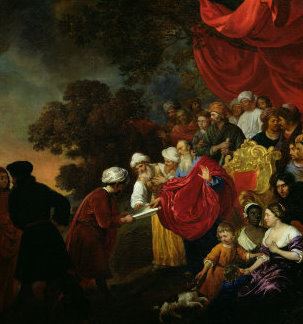
Zerubbabel displays a plan of Jerusalem to Cyrus the Great
The difficulties in the way of building the temple were not such as need had stopped the work but during this long suspension of sixteen years, Zerubbabel and the rest of the people had been busy in building costly houses for themselves. But in the second year of Darius, a light dawned upon the darkness of the colony from Babylon. In that year the spirit of prophecy suddenly blazed up with a most brilliant light among the returned captives. In a moment Zerubbabel roused from his apathy, threw his whole strength into the work. After much opposition and many hindrances find delays, the temple was at length finished, in the sixth year of Darius, and was dedicated with much pomp and rejoicing.
Although Zerubbabel’s temple was less in size than Solomon’s, God affirmed a greater honor: “The glory of this present house will be greater than the glory of the former house,” said the Lord (Haggai 2:9). The glory given onto Zerubbabel’s temple came many years later when Jesus Christ, the Son of God, came into the temple halls.
The Other Works of Zerubbabel
The only other works of Zerubbabel of which we learn from Scripture are the restoration of the courses of priests and Levites and of the provision for their maintenance, according to the institution of David (Ezra 6:18; Nehemiah 12:47) the registering the returned captives according to their genealogies, (Nehemiah 7:5) and the keeping of a Passover in the seventh year of Darius, with which the last event ends all that we know of the life of Zerubbabel.
Bible Verses about Zerubbabel
- On that day, declares the Lord of hosts, I will take you, O Zerubbabel my servant, the son of Shealtiel, declares the Lord, and make you like a signet ring, for I have chosen you, declares the Lord of hosts.” – Haggai 2:23 ESV
- “Speak now to Zerubbabel the son of Shealtiel, governor of Judah, and to Joshua the son of Jehozadak, the high priest, and to all the remnant of the people, and say, – Haggai 2:2 ESV
- In the second month of the second year after their arrival at the house of God in Jerusalem, Zerubbabel son of Shealtiel, Joshua son of Jozadak and the rest of the people (the priests and the Levites and all who had returned from the captivity to Jerusalem) began the work. They appointed Levites twenty years old and older to supervise the building of the house of the LORD. – Ezra 3:8 NIV
- they came to Zerubbabel and to the heads of the families and said, “Let us help you build because, like you, we seek your God and have been sacrificing to him since the time of Esarhaddon king of Assyria, who brought us here.” But Zerubbabel, Joshua and the rest of the heads of the families of Israel answered, “You have no part with us in building a temple to our God. We alone will build it for the LORD, the God of Israel, as King Cyrus, the king of Persia, commanded us.” – Ezra 4:2-3 NIV
- Then Zerubbabel son of Shealtiel and Joshua son of Jozadak set to work to rebuild the house of God in Jerusalem. And the prophets of God were with them, supporting them. – Ezra 5:2 NIV
Sources
Christianity.com – Zerubbabel, Smith’s Bible Dictionary
GotQuestions.org – Who was Zerubbabel in the Bible?
SOURCE
